


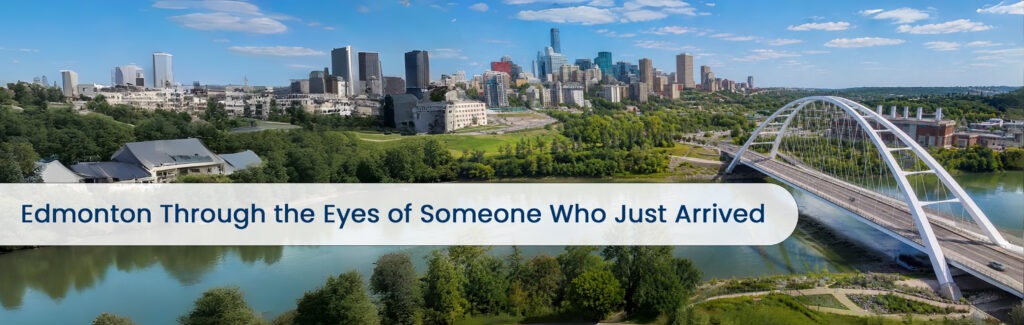
The City That Surprises People
There is a version of Edmonton that exists in the Canadian cultural imagination — flat, cold, oil-dependent, perpetually overshadowed by Calgary to the south. This version is not entirely fictional. Edmonton is flat in the way that prairie cities are flat, which is to say dramatically so, with a skyline that opens into something vast and sky-dominant in a way that most people from mountainous or forested regions find either liberating or disorienting, depending on temperament. It is cold. And its history is deeply tied to the resource economy that built this province.
But this version of Edmonton is profoundly incomplete, and it is the incompleteness that matters most to someone making an immigration decision. The city that newcomers actually encounter is a place in active, energetic transition — building new transit lines, spawning technology companies, hosting more festivals per capita than anywhere else in Canada, and receiving international immigrants at a rate that has meaningfully changed its demographic character over the past fifteen years.
Edmonton is the second-largest city in Alberta, the provincial capital, and the home of one of the world’s leading artificial intelligence research institutions. It is also one of the most affordable major cities in Canada. For someone arriving from abroad, trying to build a professional career and a stable family life simultaneously, that combination is almost uniquely valuable.

Where the Jobs Are — And Where They Are Actually Growing
The Edmonton job market has layers that are not immediately obvious from the outside, and understanding them matters for any newcomer whose immigration pathway depends on securing qualifying employment.
The most visible layer is government. Edmonton hosts the provincial legislature, dozens of government ministries and agencies, crown corporations, and regulatory bodies. The public sector is a significant and stable employer — not glamorous, but reliable, well-compensated, and offering career progression that rivals the private sector for people with the right training and credentials.
Healthcare is the second major layer and arguably the more urgent one in 2025. The Royal Alexandra Hospital, the University of Alberta Hospital, the Stollery Children’s Hospital, the Grey Nuns Community Hospital, and the Misericordia Community Hospital are all major employers, and all of them are operating under varying degrees of staffing pressure. The demand extends well beyond physicians and registered nurses — licensed practical nurses, personal support workers, medical laboratory technologists, diagnostic imaging technologists, physiotherapists, occupational therapists, pharmacists, and a long list of allied health professionals are all actively recruited. Many of these occupations qualify directly for provincial and federal immigration programs, making Edmonton’s healthcare labour shortage a genuine opportunity for internationally trained health workers willing to navigate the credential recognition process.
Technology is the fastest-growing layer. The University of Alberta’s connection to artificial intelligence research — it was home to some of the foundational work in deep learning that now underpins the entire AI industry — has created a commercial ecosystem that has expanded dramatically. Edmonton now has a functioning startup culture in AI, machine learning, agri-tech, health technology, and software development. These companies recruit globally, and many are familiar with the immigration process because they have had to become familiar with it.
Construction rounds out the picture. Edmonton has been building continuously — the Valley Line LRT expansion, mixed-use residential developments along major corridors, suburban growth on the city’s edges, and infrastructure renewal in its established neighbourhoods. Tradespeople with Red Seal certification or equivalent qualifications find Edmonton’s market receptive in a way that larger, more saturated cities often are not.
The Neighbourhoods Question — Asked Honestly
Where to live is one of the first real decisions a newcomer faces, and it tends to be made with incomplete information. Edmonton is a sprawling city, and the difference between neighbourhoods is not just aesthetic — it affects commute time, school quality, transit access, proximity to community services, and the density of cultural community that makes early settlement less isolating.
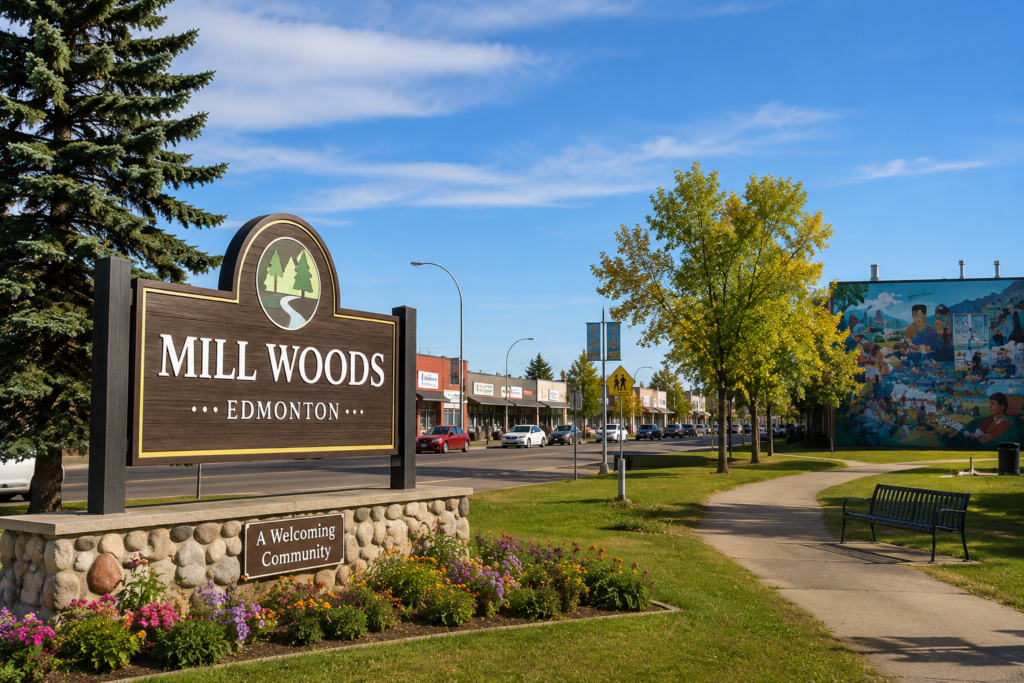
Mill Woods in southeast Edmonton has been a gateway neighbourhood for immigrant communities for decades. Its diversity is genuine and wide-ranging — South Asian, East African, Middle Eastern, and Filipino communities all have significant presence here. The practical infrastructure reflects that diversity: multicultural grocers, cultural restaurants, places of worship across traditions, and community organizations specifically serving newcomers. Transit connections to downtown are adequate, and housing costs remain among the most accessible in the city.
The northeast quadrant has historically been home to Somali, Ethiopian, and Afghan communities, and the social infrastructure serving those communities — legal aid clinics, settlement organizations, cultural associations — is concentrated here. It is an area where newcomers can access informal support networks that no government program can replicate, the kind that comes from people who have already navigated the same systems you are trying to figure out.
West Edmonton, particularly areas like Lewis Estates and the communities along the Whitemud Drive corridor, draws professional families and has a large Filipino community. These are newer suburban communities with good school infrastructure but less transit connectivity — households here typically need a vehicle.
South Edmonton, from Millwoods through to the newer communities of Windermere and Terwillegar, offers newer housing stock and excellent school options, and is popular with professional families at a slightly higher income bracket. The commute to downtown requires a car, but the communities are well-serviced and growing.
Older established neighbourhoods closer to the river valley — Strathcona, Ritchie, Bonnie Doon, Inglewood — are attracting younger professionals and offer a walkable, dense urban feel that is unusual in a prairie city. These areas have seen significant gentrification and are now priced accordingly, but they offer a quality of urban experience that Edmonton rarely gets credit for.

The University of Alberta and Its Ripple Effects
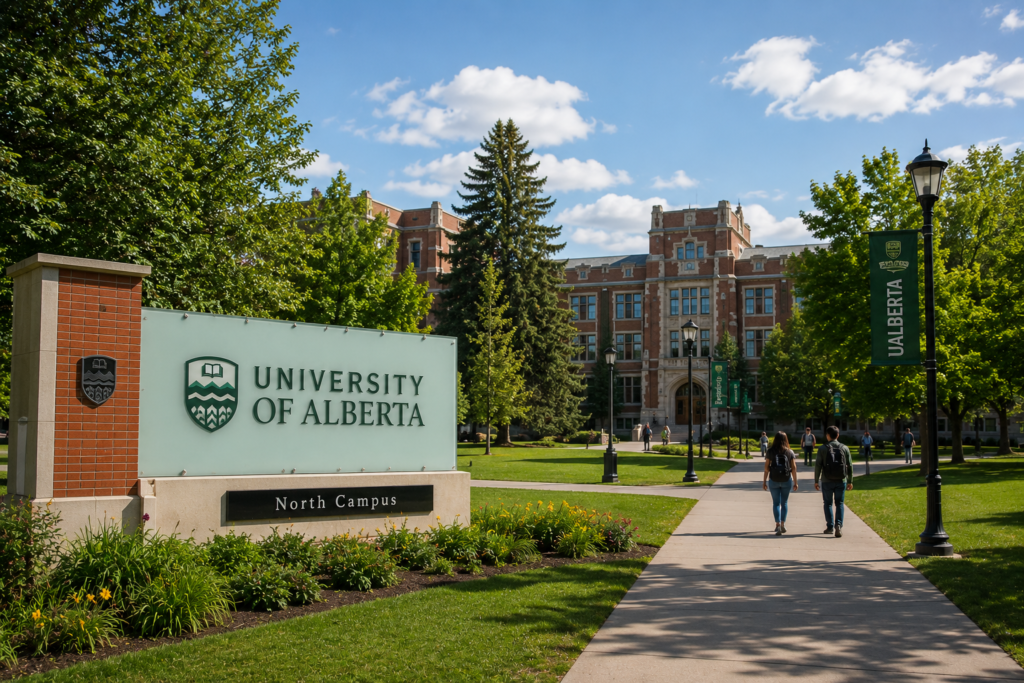
Any honest account of Edmonton as an immigration destination has to spend time on the University of Alberta, because its influence on the city extends far beyond the academic calendar.
The U of A is a genuinely world-class research institution with particular strength in artificial intelligence, medical research, agricultural science, engineering, and environmental science. Its presence means that Edmonton has a permanent population of international students, researchers, and faculty who arrive from every corner of the world and who, in many cases, stay. The university’s graduate programs are a feeder into Edmonton’s technology sector, and its medical schools and teaching hospitals are deeply integrated with the city’s healthcare system.
For immigration purposes, this matters in several ways. International students who complete degrees or diplomas at the U of A can access Post-Graduation Work Permits that allow them to work in Edmonton while building the Canadian work experience that qualifies them for the Canadian Experience Class or the AAIP’s streams. MacEwan University, NAIT, NorQuest College, and Concordia University of Edmonton are also designated learning institutions whose graduates qualify for the same pathways.
Edmonton is also home to a significant English language training infrastructure. NorQuest College’s Language Instruction for Newcomers to Canada program, various private language schools, and the language training offered through settlement organizations collectively serve a population of learners at every level. For newcomers whose English proficiency needs improvement, Edmonton’s options are substantial.
Practical Things Nobody Puts in the Brochure
Car ownership is not optional for most Edmonton residents. The LRT network is expanding — the Valley Line is a significant addition — but the city’s scale and the distribution of employment and services means that relying exclusively on transit is difficult for most working families. Budget for a vehicle, budget for insurance (which is expensive in Alberta), and budget for winter tires, which are not legally required but are practically essential.
The healthcare enrollment process for newcomers is straightforward but has a waiting period. Alberta Health Care Insurance Plan coverage begins three months after you establish residency in the province. In that window, you are responsible for any medical costs. Private insurance for the three-month gap is available and is worth purchasing, especially if you have children.
School enrollment can happen at any time of year. Both Edmonton Public Schools and Edmonton Catholic Schools have English Language Learning programs that serve newcomer children, and the intake process is designed to accommodate families arriving mid-year. Finding a school with a strong ELL program early makes a meaningful difference in how quickly children adjust.
The social infrastructure for newcomers in Edmonton is genuinely strong, but it requires active engagement. The settlement organizations — the Centre for Newcomers, Catholic Social Services, the Edmonton Mennonite Centre for Newcomers, and others — offer services that are free and substantive, but they do not come to you. The newcomers who build stable lives in Edmonton fastest are almost always the ones who engaged with these systems in their first weeks rather than their first year.


Edmonton as a Long-Term Decision
The city that newcomers leave Edmonton for, when they do leave, is almost never a better opportunity — it is usually a familiar one. Family networks in Toronto or Vancouver, a specific job offer in a particular city, the pull of an established community. These are real reasons and legitimate ones. But the newcomers who stay in Edmonton tend to stay because the city gives them something the alternatives cannot easily replicate: a combination of professional opportunity, financial breathing room, community diversity, and physical space that produces a quality of life that larger, more expensive cities simply do not deliver at equivalent income levels.
Edmonton does not sell itself loudly. It is not a city that has mastered its own marketing. But the people who choose it, who figure out the job market, who find their neighbourhood, who discover the river valley in summer and the festival calendar in autumn — they tend to become advocates for it in a way that no promotional campaign could replicate.
That quiet advocacy is one of Edmonton’s most distinctive features. It is also, in a modest way, what this blog is trying to do.