

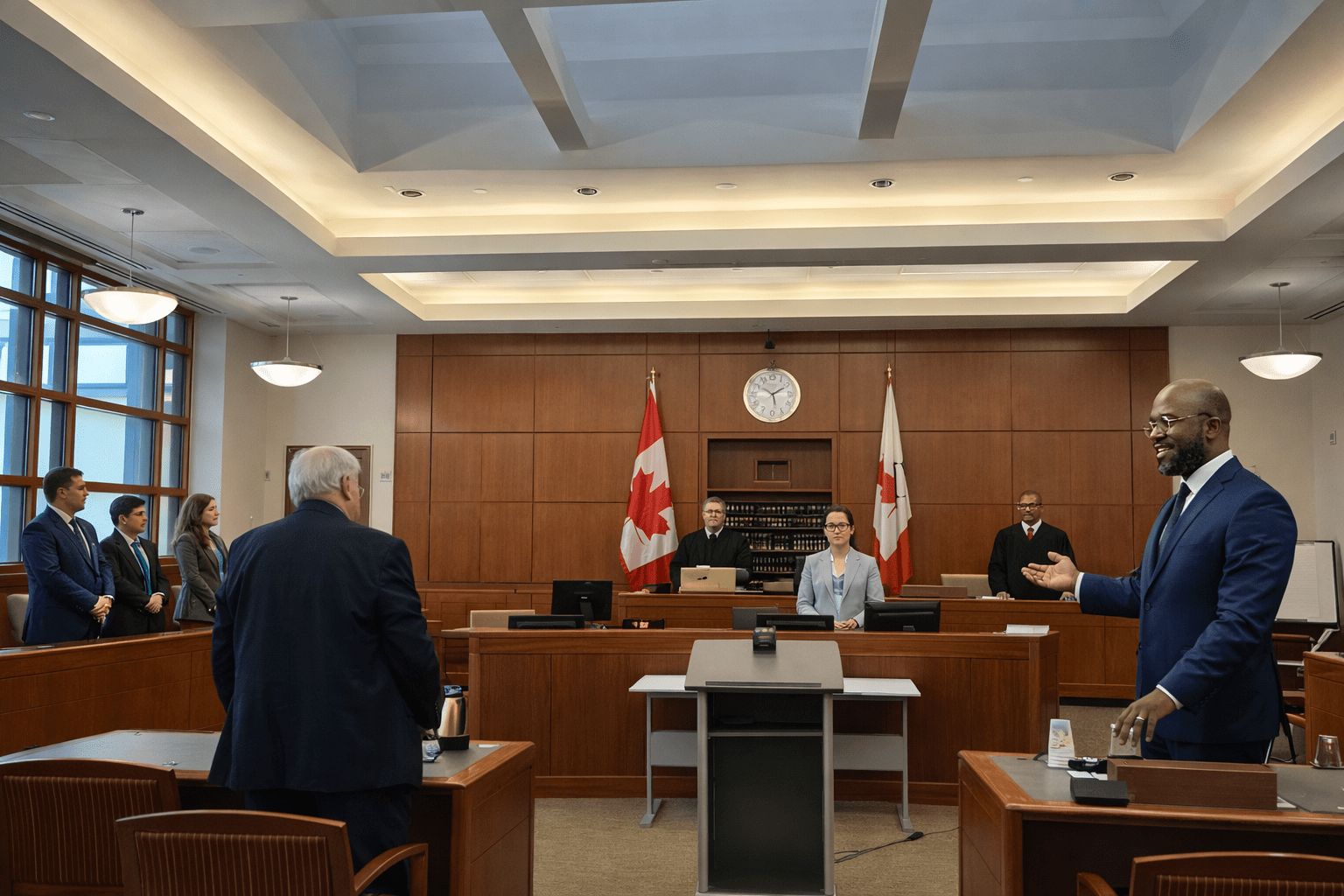

The Question Nobody Asks Until It Is Too Late
Every person who has ever sat in a waiting room outside an RPD hearing room has, in some form, asked themselves the same question: what is the person in that room actually trying to figure out? What is the decision-maker looking for when they listen to testimony, review documents, and consider whether to grant or refuse protection?
The answer is simpler and more demanding than most people expect. The Refugee Protection Division Member is trying to answer one question: do I believe this person? Not whether their country has human rights problems — they likely already know it does. Not whether the type of persecution they describe happens to people in their country — country condition evidence almost always confirms that it does. The question is whether this specific person, sitting in front of them, genuinely experienced what they say they experienced, genuinely fears what they say they fear, and genuinely cannot access safety within their home country or from its government.
That question — the credibility question — determines the outcome of the overwhelming majority of refugee hearings in Canada. Understanding what it actually means, and how a decision-maker evaluates it, is the foundation of any serious preparation for an RPD hearing.
How the Refugee System Is Structured — and Why It Matters
Canada’s refugee protection system operates under the Immigration and Refugee Protection Act and is administered by the Immigration and Refugee Board, an independent administrative tribunal. The IRB has four divisions, and for most refugee claimants the relevant one is the Refugee Protection Division, which conducts first-instance hearings on protection claims made inside Canada.
The IRB is independent of the government ministries that manage immigration enforcement — it does not report to the Minister of Immigration and it is not subject to direction from CBSA or IRCC on individual decisions. This independence is not incidental. It is the structural guarantee that protection claims are assessed on their merits, not on enforcement priorities or political considerations.
RPD Members are decision-makers appointed through a merit-based process. They receive training in refugee law, country conditions, and hearing procedures. They are not judges — RPD proceedings are administrative rather than judicial — but they exercise quasi-judicial functions and their decisions carry the full weight of a formal legal determination.
Understanding the IRB’s structure matters for a practical reason: it tells you what the hearing is and what it is not. It is not a court proceeding with the formality and procedural constraints of litigation. It is a fact-finding process conducted by a trained decision-maker who is genuinely trying to determine whether you meet the legal definition of a refugee or person in need of protection. The tone is less adversarial than a courtroom and more inquisitorial — the Member is not simply evaluating competing arguments but actively trying to understand what is true.


The Basis of Claim Form: Where Every Hearing Really Begins
The most important document in a refugee case is not the country condition evidence bundle, the supporting affidavits, or the expert report on human rights conditions. It is the Basis of Claim form — the written statement in which the claimant describes, in their own words, who they are, what happened to them, and why they cannot return.
The BOC is completed early in the process, often within weeks of making the claim, and it is submitted to the IRB before the hearing. It becomes the anchor for everything that follows. The Member will read it before the hearing begins. They will refer to it throughout. They will note, precisely, anything in oral testimony that is inconsistent with what the form says.
This creates a dynamic that trips up a remarkable number of claimants. A BOC completed quickly, without legal assistance, under stress, in a second or third language, often contains omissions, imprecisions, or compressed accounts of complex events. Those imprecisions are not automatically damaging — a skilled representative can address them proactively and in context. But left unaddressed, they become credibility problems at the hearing.
The standard the IRB applies to BOC inconsistencies is not a generous one. If your testimony describes events in a sequence that differs from your form, or adds significant details that were absent from the written account, or characterizes a relationship or event differently than the form does, the Member will ask about it. The question will not be asked casually. It will be asked precisely because the Member wants to understand why the accounts differ, and the answer will directly affect their assessment of whether you are telling the truth.
The practical implication is straightforward: the BOC should be treated with the same seriousness as the hearing itself. It is not a draft. It is not a preliminary sketch. It is a legal document that will be used to evaluate your credibility, and it should be prepared with legal assistance, reviewed carefully, and treated as final once submitted.

What Happens in the Hearing Room
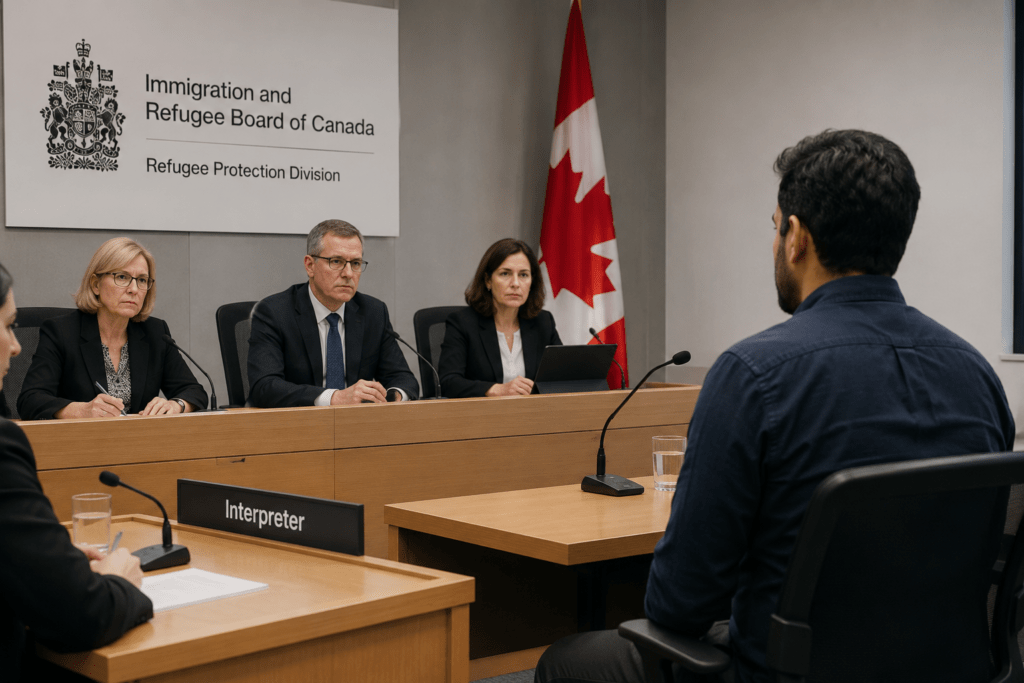
RPD hearings are not public proceedings. They take place in hearing rooms that are smaller and less formal than courtrooms — typically a conference table format with the Member, the claimant, the claimant’s counsel, an interpreter if needed, and occasionally an IRB officer whose role is to ask questions on behalf of the tribunal.
The format follows a predictable structure, though the content varies enormously by case. The Member will establish identity early — confirming that the person before them is who they say they are, that their documents are genuine, and that the basic biographical facts in the BOC are accurate. This phase of the hearing is often underestimated by claimants. Document authenticity is examined carefully, and questions about identity — place of birth, family structure, education, employment history — are not formalities. They are the foundation on which the rest of the hearing’s credibility assessment rests.
The substantive examination then follows. If the claimant has legal counsel, counsel typically conducts a direct examination first, taking the claimant through their narrative in an organized way that establishes context, builds chronology, and anticipates the questions the Member is likely to ask. Done well, this examination allows the claimant to present their story coherently and completely, reducing the risk that important context will be missing when the Member begins their own questions.
The Member’s examination is where most hearings are won or lost. Members ask detailed questions. They probe the plausibility of specific events — why did you wait three months before reporting the first threat? How did you know the person who threatened you was connected to the organization you describe? If you were being watched, why were you able to travel to a neighbouring city without incident? These questions are not malicious. They are precisely what a careful fact-finder should ask. But they require preparation that goes far beyond knowing your own story — they require understanding how your story will sound to someone encountering it for the first time, with knowledge of your country’s conditions and the general patterns of persecution that characterize it.
Country Condition Evidence: The Frame Around Your Story
No refugee hearing exists in an informational vacuum. Every RPD Member approaches the hearing with background knowledge of the claimant’s country, drawn primarily from the IRB’s National Documentation Package — a curated collection of country condition reports, human rights documentation, academic research, and government assessments that the IRB maintains for most countries from which claims originate.
This matters because the NDP shapes what the Member already believes before the hearing begins. If your claim involves a type of persecution that is well-documented in the NDP — political persecution under a particular regime, violence against a specific ethnic or religious minority, targeted harm against a particular social group — the Member’s background knowledge is likely to be sympathetic context for your testimony. If your claim involves risks that the NDP does not support, or that the NDP characterizes differently than you do, the evidentiary burden on your personal account increases.
This is why claimants and their counsel should review the NDP for their country before the hearing. Not to conform their testimony to it — that would be both dishonest and legally problematic — but to understand what the Member already knows, to identify gaps between their personal experience and the documented country conditions, and to prepare submissions that either resolve those gaps or explain why their personal situation differs from the general pattern.
Independent country condition evidence — reports from Amnesty International, Human Rights Watch, UNHCR, and similar organizations — can supplement or challenge the NDP in specific cases. Introducing this evidence effectively requires knowing what the NDP says, identifying where independent evidence provides additional support or context, and presenting it in written submissions that connect the documentary evidence to the specific facts of the claimant’s case.
After the Hearing: The Decision and What Follows
RPD Members may give an oral decision at the end of the hearing or reserve for a written decision delivered later. Oral decisions at the hearing’s conclusion are common in straightforward cases in either direction — a clearly credible claim is sometimes accepted on the spot, and a clearly problematic one is sometimes refused in the same way.
A positive decision grants protected person status. The claimant can remain in Canada and apply for permanent residence. A negative decision, in most cases, gives the claimant the right to appeal to the Refugee Appeal Division within fifteen days. The RAD is a paper-based review that examines whether the RPD made errors in fact, law, or mixed fact and law. It does not automatically hold a new oral hearing, though it may in some circumstances.
If the RAD also refuses the claim, judicial review at the Federal Court is available, followed — in cases where removal is imminent — by the PRRA process. Each step narrows the options and heightens the stakes.
This progression is why the RPD hearing deserves the most intensive preparation of any stage in the refugee process. Everything that follows a negative RPD decision is shaped by what happened in that hearing room. A credibility finding at the RPD level is extremely difficult to overturn at the RAD or Federal Court. Getting it right the first time is not just preferable — it is, in most cases, essential.