


The Letter Tells You Very Little
Immigration refusal letters in Canada are, as a category, remarkable for what they do not say. They arrive — by portal message, by mail, occasionally both — in formal bureaucratic language that announces the outcome without explaining it. “We are not satisfied that you will leave Canada at the end of your authorized stay.” “We are not satisfied that you meet the requirements of the program under which you applied.” “Your application has been refused.”
The claimant reads these sentences and typically understands them in roughly the same way they would understand a closed door: as a verdict. What they almost never understand from the letter alone is the reasoning behind it — the specific concerns the officer had, the evidence they found insufficient, the inconsistencies they identified, the legal framework they applied. That information exists. It is documented, in detail, in the officer’s internal notes in the Global Case Management System. But it is not in the letter.
This gap between what the refusal says and what actually decided it is where most complex refusal cases begin. And it is where most of the strategic opportunities lie.
Getting the Notes: The Most Important First Step
The GCMS notes — sometimes called IRCC notes or officer notes — are the internal record of an officer’s analysis of your application. They document what evidence was reviewed, what concerns arose, how those concerns were assessed, and how the officer reached their conclusion. In complex refusal cases, they are often the most important document in the entire file.
Requesting your GCMS notes is done through an Access to Information and Privacy request. The process takes weeks, sometimes months, and the notes arrive with redactions for third-party information. But what remains is usually revealing in ways that transform how a refused applicant understands their situation.
An officer who refused a spousal sponsorship because they were not satisfied the relationship was genuine will have documented specific inconsistencies — answers that differed between the sponsor and the applicant on questions about how they met, what the other person’s family members’ names are, what their home city looks like. An officer who refused a work permit application because they were not satisfied the applicant would leave Canada will have documented the factors they found concerning — prior refusals, weak ties to the home country, the nature of the job offer. An officer who found misrepresentation will have identified the specific documents or statements they considered fraudulent or misleading.
Without the notes, responding to a refusal is guesswork. With the notes, it becomes a targeted exercise in either addressing the officer’s concerns directly or identifying the legal error in their reasoning.

Misrepresentation: The Most Consequential Finding
Section 40 of the Immigration and Refugee Protection Act deals with misrepresentation — the direct or indirect provision of false or misleading information, or the withholding of material facts, that could induce an error in the administration of the Act. A finding of misrepresentation under section 40 carries a five-year bar on any application under IRPA and, for people inside Canada, typically triggers removal proceedings.
What makes misrepresentation cases genuinely complex is the breadth of circumstances that can attract the finding. Obvious fraud — forged documents, fabricated employment records, falsified credentials — is one end of the spectrum. But section 40 has been applied in cases involving translation errors introduced by a third party, omissions made by an immigration consultant without the applicant’s knowledge, technical inaccuracies in how work history was characterized, and prior immigration applications that were not disclosed because the applicant did not understand they needed to be.
The legal principle that makes these cases hard is simple and brutal: you are responsible for what is submitted in your name. The courts have consistently upheld this, though they have also developed important nuances. The procedural fairness principle requires that before a misrepresentation finding is made, the applicant must be given an opportunity to respond — usually in the form of a Procedural Fairness Letter that identifies the specific concern and invites a reply. Failing to respond to a PFL, or responding inadequately, significantly narrows the options for challenging the final decision.
A misrepresentation finding that has become final can be challenged at the Federal Court on judicial review, but the court’s standard of review is deferential — it is asking whether the officer’s decision was reasonable, not whether it was correct. Cases succeed at the Federal Court where the officer applied the wrong legal test, failed to consider relevant evidence, or denied procedural fairness. They are much harder to win on the pure merits of factual disagreement.
The Spousal Sponsorship Refusal — and Why It Is Not the End
Spousal and partner sponsorship refusals are emotionally among the most difficult outcomes in Canadian immigration, because they do not merely affect a single person’s plans — they physically separate families and leave couples in different countries, sometimes for years.
The grounds for spousal refusal are narrower than people often assume. An officer can refuse because they are not satisfied the relationship is genuine — that it was entered into primarily for immigration purposes rather than in good faith. They can refuse because the sponsor is ineligible — prior sponsorship failures, income issues in limited circumstances, or the sponsor being inadmissible themselves. In both cases, the refused applicant has the right to appeal to the Immigration Appeal Division of the IRB.
The IAD appeal is a genuinely meaningful process, not a rubber-stamp review. It is a fresh hearing — new evidence is admissible, witnesses can testify, and the IAD Member makes an independent assessment of the evidence without deference to the original officer’s finding. This means that a spousal sponsorship refused at the visa office can be approved on appeal when the couple presents a fuller evidentiary record of their relationship — letters, photographs, financial records, communication history, witness testimony from family members who know them both.
IAD appeals succeed regularly when couples are prepared and well-represented. The key is understanding that the appeal is not simply a complaint about the officer’s decision — it is a new opportunity to establish the genuineness of the relationship, and it should be treated as such from the first day.

Visitor Visa Refusals: The Frustration With a Strategy
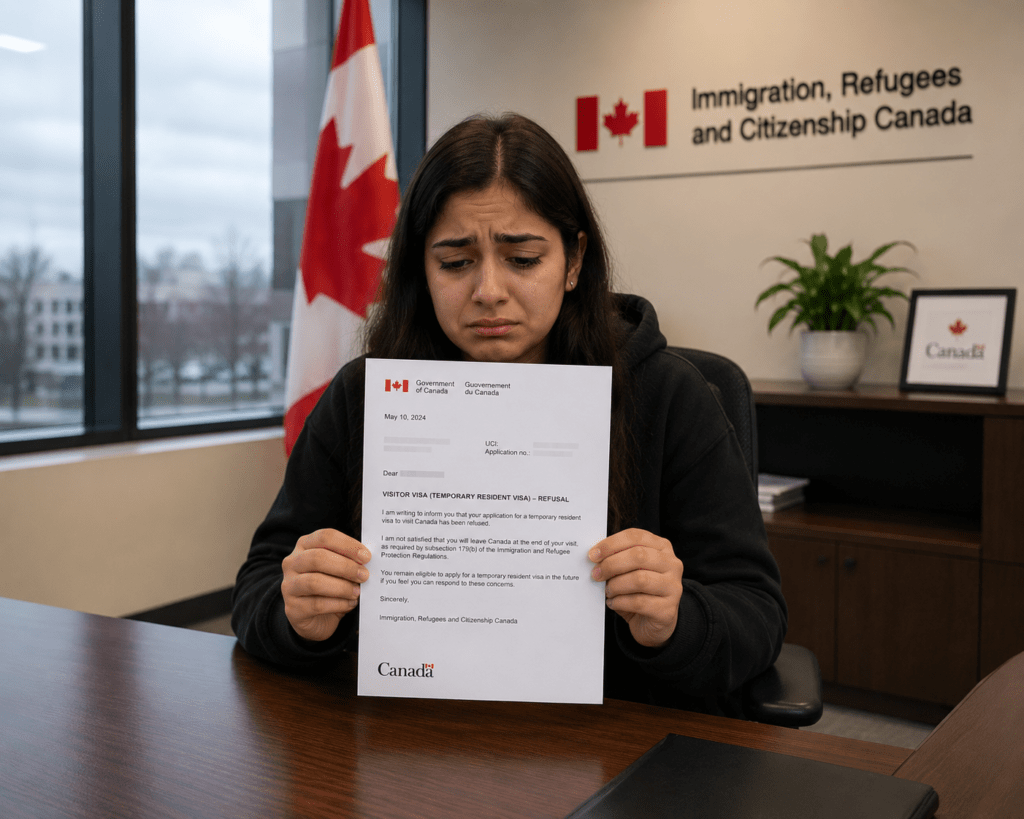
Visitor visa refusals are the most numerically common refusal in the Canadian immigration system, and they are also the category where applicants most often feel — rightly — that the process is opaque and the outcome arbitrary.
The frustration is understandable. Officers have broad discretion in visitor visa assessments. The refusal language is generic. The GCMS notes, when obtained, sometimes reveal reasoning that feels thin or conclusory. And the formal options for challenging a visitor visa refusal are limited — there is generally no right of appeal to the IAD, and judicial review is available only if there is a legal error.
The strategic response to a visitor visa refusal is almost always to reapply rather than to litigate. But reapplying without understanding and addressing the original refusal concerns is a reliable way to collect multiple refusals that progressively damage future applications. Each additional refusal is itself a factor that officers will note in subsequent assessments.
A properly structured reapplication identifies, from the GCMS notes, exactly what concerned the officer. Weak ties to home country? The reapplication needs to document those ties with specificity — employment confirmation letters, property ownership documents, family obligations, active business involvement. Concern about the applicant’s financial means? Current, detailed bank statements and an explanation of the source of funds. Unclear purpose of visit? A detailed itinerary, invitation letters, and documentation from the host in Canada.
The reapplication should include a cover letter that explicitly acknowledges the prior refusal, addresses each noted concern directly, and explains what has changed or what additional evidence resolves the officer’s uncertainty. Officers see thousands of reapplications. The ones that succeed are the ones that make the officer’s job easy — not by arguing with the prior decision but by removing the reasons for it.
The Federal Court Option: When It Is Worth It
Judicial review at the Federal Court of Canada is available for most negative immigration decisions, but it is a remedy with specific characteristics that applicants need to understand before pursuing it.
The Court is not an appeal tribunal. It does not hear new evidence, does not retry the facts of the case, and does not substitute its own assessment of the applicant’s credibility or circumstances for the officer’s. It reviews the officer’s decision for legal error — unreasonable reasoning, failure to consider relevant evidence, breach of procedural fairness, or the application of the wrong legal test.
Within those parameters, the Court does significant and meaningful work. Officers sometimes produce decisions that are unreasoned, internally inconsistent, or based on factors they were not entitled to consider. When the GCMS notes reveal that kind of decision-making, judicial review is not only available but likely to succeed.
The timelines are unforgiving. Most immigration decisions must be challenged at the Federal Court within fifteen to sixty days of the decision, depending on the type of application. Missing the deadline is jurisdictional — the Court cannot extend it without compelling justification, and compelling justification is rare. The day a refusal arrives is the day to consult a lawyer about whether judicial review is available and appropriate.

The Underlying Pattern Across All Complex Refusals
What runs through every complex refusal case — misrepresentation, criminal inadmissibility, spousal refusals, visitor visa refusals — is a consistent dynamic: the officer made a decision based on a record that was incomplete, misunderstood, or inadequately presented, and the applicant now has to either correct the record or identify the legal error in how it was evaluated.
Neither of those tasks is simple. Both require a clear-eyed assessment of what the officer actually decided, what evidence they had, what they were legally entitled to consider, and what procedural rights the applicant has. That assessment almost always begins with the GCMS notes — which is why requesting them is the first practical step after any significant refusal.
The applicants who recover from complex refusals most effectively are the ones who do not treat the refusal as an ending. They treat it as a document — a detailed account of what went wrong, and therefore a detailed map of what needs to be addressed.